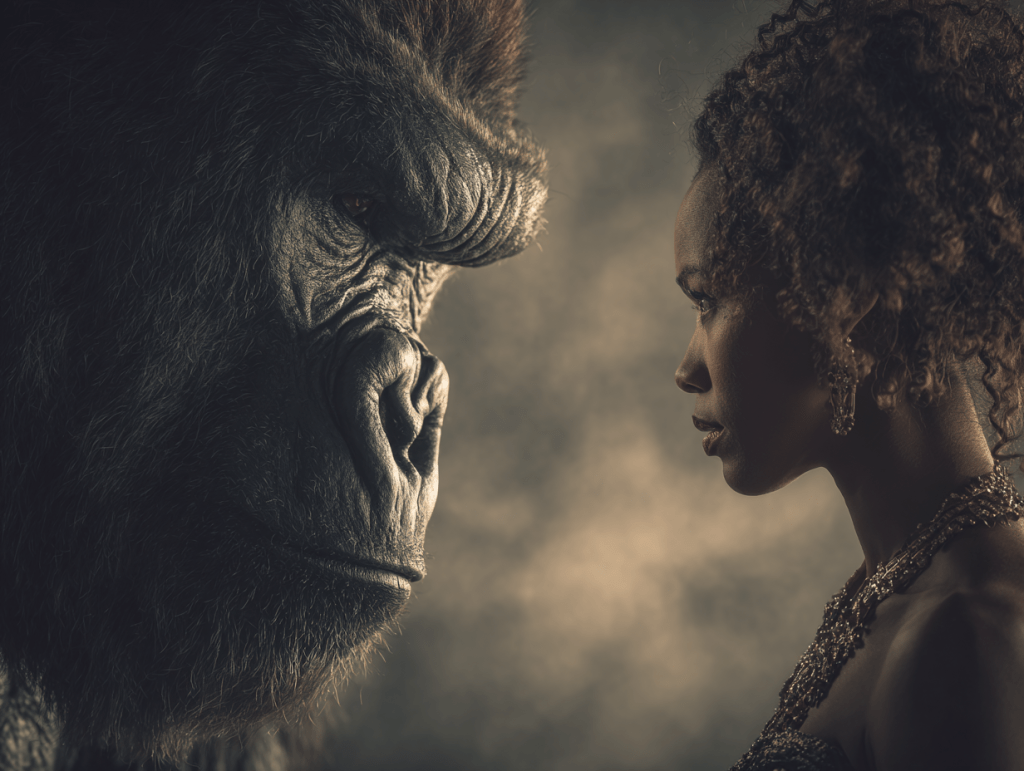
The Kong movies—especially King Kong (from the 1933 original to the 2005 and 2017 versions like Kong: Skull Island)—offer surprisingly deep insights into relationships. Here are a few key themes they highlight:
1. Connection Beyond Words
Kong forms a bond with a human (often a woman like Ann Darrow), showing that real connection can transcend language, culture, and even species. It’s a metaphor for empathy and understanding someone completely different from you.
2. The Pain of Misunderstood Love
Kong’s affection is often seen as dangerous or threatening, which reflects how love or deep care can be misinterpreted—especially when expressed differently than the norm. This shows the fragility of relationships when there’s fear or lack of understanding.
3. The Destructive Side of Possessiveness
Some versions of the story show Kong as protective to a fault, bordering on possessive. This becomes a commentary on how love can turn destructive when it’s rooted in control rather than mutual respect.
4. Human Exploitation of Nature (and Each Other)
The humans who capture and display Kong often do so out of greed or curiosity, ignoring the emotional or relational consequences. This mirrors real-life relational imbalances—when one side seeks to use or control rather than connect.
5. Tragic Beauty of Sacrificial Love
Kong often sacrifices himself to protect someone he cares for. His death isn’t just tragic—it’s a reflection of pure, unselfish love, even when it comes at a great cost.
So, while it’s a monster movie on the surface, Kong teaches us a lot about the power of connection, the cost of misunderstanding, and the importance of seeing the heart—especially in unexpected places.ls them in different directions. The movie shows that even the strongest love can be tested by timing and ambition—and sometimes love means letting go so both people can grow. But if it’s real, it might just find its way back.
Do you believe in Sacrificial Love?
Sacrificial love is at the heart of King Kong’s story—and it’s one of the most emotionally resonant themes in the film.
Kong doesn’t just protect the woman he bonds with; he gives everything for her—his freedom, his safety, and ultimately, his life. Despite being feared, hunted, and misunderstood, he never turns on her. In the end, he dies not out of weakness but out of love—choosing to shield someone else instead of saving himself.
This kind of love reflects the deepest kind of relationship: one rooted in selflessness. It echoes the biblical concept of love from John 15:13: “Greater love has no one than this: to lay down one’s life for one’s friends.”
What makes Kong’s love so powerful is that it’s not romantic—it’s protective, tender, and pure. He asks for nothing in return. It shows us that real love—whether in friendship, family, or something deeper—isn’t about gaining, but giving, even when it hurts.
Sacrificial love in the movie also forces us to reflect:
- Would we give up our comfort or pride to protect someone we love?
- Are we willing to be misunderstood or judged in order to stand by someone who needs us?
Kong reminds us that love isn’t always polished or perfect—it’s often raw, messy, and costly—but it’s also the most human thing there is… even in a giant, misunderstood creature.
What about sacrificial love speaks to you personally?
 Living Between 'Breath & Bloom